I’ve been talking a lot about coming home. About how the Father is waiting. About how the door is still open. About how it’s never too late to return.
And maybe you’ve been thinking: Okay, I get it. You want me to go back to church.
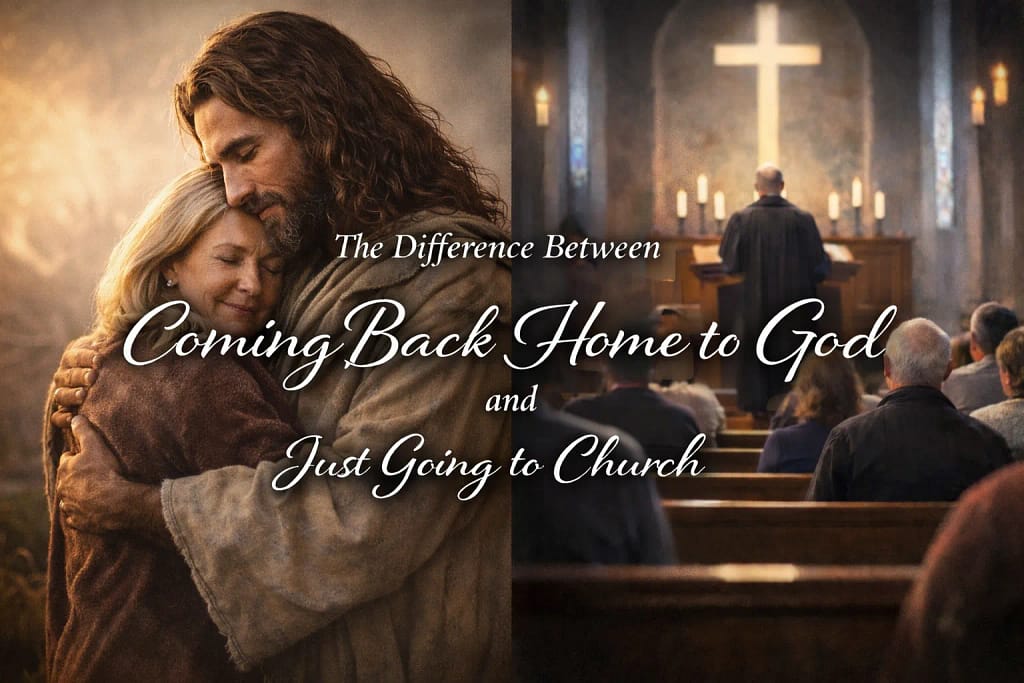
But here’s what I need you to understand: Coming home to Jesus and just going to church are not the same thing.
Not even close.
You can go to church every Sunday and still be far from home. You can attend services, volunteer in ministries, serve on committees, and never actually come home to the Father.
And conversely, you can come home to Jesus—truly, deeply, authentically come home—and not step foot in a church building for months.
Because coming home isn’t about attendance. It’s not about filling a seat or checking a box or meeting a religious obligation.
Coming home is about returning to relationship with the Father.
And that’s a completely different thing than just showing up to a building on Sunday morning.
Let me explain what I mean.
Going to Church Is About a Place. Coming Home Is About a Person.
When you “go to church,” you’re going to a location. A building. A service. An event.
You show up. You sit down. You sing a few songs. You listen to a sermon. You shake some hands. You leave.
It’s transactional. It’s external. It’s something you do.
But coming home? Coming home is about reconnecting with Someone you’ve been away from.
It’s not about a place. It’s about a Person—God Himself.
Coming home means turning your heart back toward the Father. It means opening yourself up to relationship with Him again. It means letting Him in, not just letting yourself into a building.
You can do that in a church. But you can also do that in your car, in your living room, on a walk, or at 2 AM when you can’t sleep.
Coming home happens when you acknowledge: “God, I’ve been far from You. And I don’t want to be anymore.”
That’s it. That’s the beginning of coming home.
And it has nothing to do with whether you’re sitting in a pew.
Going to Church Is About Behavior. Coming Home Is About the Heart.
When people talk about “getting back to church,” they’re usually talking about behavior modification.
“I need to start going to church again.” “I should be attending more regularly.” “I need to get more involved.”
It’s all about doing. Acting. Performing.
And look, I’m not saying church attendance doesn’t matter. It does. Community matters. Gathering with other believers matters.
But if all you’re doing is changing your behavior—if you’re going through the motions without your heart being engaged—you’re just going to church. You’re not coming home.
Coming home starts in the heart. It’s an internal shift, not just an external one.
It’s when you stop running and turn around. When you stop pretending you’re fine on your own and admit you need God. When you stop performing and start being honest.
You can change your behavior without changing your heart. But when your heart changes, your behavior follows naturally.
Coming home is the heart change. Going to church might be one of the behaviors that follows, but it’s not the thing itself.
Going to Church Can Be About Guilt. Coming Home Is About Love.
A lot of people go to church because they feel like they’re supposed to.
Because their parents expect it. Because it’s what “good Christians” do. Because they feel guilty when they don’t. Because they’re afraid of what God will do if they stop showing up.
That’s not coming home. That’s obligation. That’s fear. That’s performance.
And honestly? God doesn’t want that.
He doesn’t want you to show up out of guilt or obligation or fear. He doesn’t want you to drag yourself to a service because you think you have to or because you’re trying to earn His approval.
Coming home is about love, not guilt.
It’s realizing that you miss Him. That life away from Him isn’t actually better. That you want to be close to Him again—not because you have to, but because you want to.
It’s the prodigal son saying, “I will arise and go to my father”—not because someone forced him, not because he was obligated, but because he came to his senses and remembered what home was like.
You come home because you want to be home. Not because someone told you to.
Going to Church Can Be Performative. Coming Home Is Vulnerable.
Here’s what often happens when people “go back to church”:
They put on their best face. They smile. They say all the right things. They act like they have it all together.
They perform.
Because church can feel like a place where you have to pretend. Where you have to look like you’re doing well spiritually. Where you can’t let people see the mess.
But coming home? Coming home requires vulnerability.
It’s the prodigal son walking up to his father in rags, smelling like pigs, with nothing to offer but honesty: “I have sinned. I am not worthy to be called your son.”
It’s admitting you don’t have it together. It’s being honest about where you’ve been and what you’ve done. It’s showing up as you actually are, not as you think you should be.
Coming home means dropping the performance and being real.
And yes, eventually that might happen in the context of a church. But it starts between you and God. Just you and Him. No pretense. No performance. Just honest, vulnerable confession and reconnection.
Going to Church Can Happen While You’re Still Running. Coming Home Means You’ve Turned Around.
Here’s the thing that a lot of people don’t realize: You can go to church while still running from God.
You can show up every Sunday and still have your heart far from Him. You can be physically present in the building while spiritually still in the far country.
You can sing the songs without meaning them. Hear the sermons without letting them penetrate. Go through all the motions while keeping God at arm’s length.
But coming home requires turning around.
It requires stopping the running. Facing the direction of home. Taking steps toward the Father instead of away from Him.
You can’t come home while you’re still running. You have to turn around first.
And when you do—when you genuinely turn your heart back toward God—that’s when coming home begins. Whether or not you’re in a church building at the time.
Going to Church Is Something You Can Do Alone. Coming Home Brings You Into Family.
Ironically, you can go to church and be completely isolated.
You can sit in a room full of people and never actually connect with any of them. You can attend for years and remain anonymous. You can fulfill the “going to church” requirement without ever being known.
But coming home? Coming home brings you back into family.
When the prodigal son came home, he wasn’t just returning to a house. He was returning to relationship. With his father. With his family. With the community he’d left behind.
Coming home means you’re not alone anymore. It means you’re reconnecting—not just with God, but with His people. With brothers and sisters who are also on the journey.
And yes, that often happens in the context of church. But it’s not about attendance—it’s about actual relationship. Actual community. Being known and loved and walking this road together.
You can go to church and remain isolated. But when you come home, you’re brought back into family.
What Coming Home Actually Looks Like
So if coming home isn’t the same as going to church, what is it?
Coming home looks like:
Turning your heart back toward God. Acknowledging that you’ve been far from Him and you don’t want to be anymore. Choosing relationship over distance.
Being honest about where you are. Not pretending. Not performing. Just bringing your actual self—mess and all—to the Father.
Opening yourself back up to Him. Letting Him in. Letting Him speak to you. Letting Him love you. Not keeping Him at arm’s length.
Trusting His love again. Believing that He actually wants you back. That He’s not angry or disappointed or waiting to punish you. That He’s ready to embrace you.
Starting to live in relationship with Him. Talking to Him throughout your day. Listening for His voice. Making decisions with Him instead of without Him. Inviting Him into your actual life.
Reconnecting with His people. Finding safe community. Being willing to be known. Walking this road with others instead of trying to do it alone.
Notice: None of those things require a church building. Some of them might happen in a church. But the coming home part? That’s between you and God.
Why This Distinction Matters
Here’s why I’m being so insistent about this difference:
If you think coming home just means going to church, you might do that and still miss the whole point.
You might start attending services, checking the box, fulfilling the obligation—and never actually reconnect with God.
You might go through all the motions of religion and still have a heart that’s far from the Father.
And then when it feels empty or pointless or burdensome, you’ll walk away again. Because you never actually came home in the first place. You just started going to a building.
Coming home has to start with the heart. With relationship. With turning back toward the Father.
And yes, for most people, that will eventually involve church. Community. Gathering with other believers.
But it doesn’t start there. It starts in the quiet moment when you acknowledge your need for God. When you turn around and start walking back toward Him. When you open your heart back up and let Him in.
That’s coming home. Everything else flows from that.
An Invitation
So let me be clear about what I’m inviting you to:
I’m not inviting you to start going to church (though you might).
I’m not inviting you to join a program or sign up for a ministry or fulfill a religious obligation (though you might do those things eventually).
I’m inviting you to come home to the Father.
To turn your heart back toward Him. To be honest about where you are. To open yourself back up to relationship with Him. To trust His love again. To start living in connection with Him instead of distance from Him.
That might happen in a church building. It might happen in your car. It might happen in your living room at 2 AM when you finally whisper, “God, I can’t do this on my own anymore.”
The location doesn’t matter. The posture of your heart does.
Are you ready to come home?
Not to a building. Not to a program. Not to an obligation.
To the Father. To relationship. To the place you were always meant to be.
Because that’s what He’s waiting for. Not your attendance. Not your performance. Not your religious activity.
He’s waiting for your heart. For you to turn back toward Him and say, “I want to come home.”
And when you do—whether it’s in a church or anywhere else—He’ll be ready.
Watching the road. Ready to run. Prepared to welcome you back with open arms.
Not because you showed up to the right place or said the right words or fulfilled the right requirements.
But because you came home. And that’s all He’s ever wanted.
The Question
So here’s what I want to ask you:
Have you come home? Or have you just been going to church?
Have you reconnected with the Father? Or have you just been fulfilling an obligation?
Is your heart engaged? Or are you just going through the motions?
Because if it’s the latter—if you’ve been showing up to a building but your heart is still far away—I want to invite you to something deeper.
Come home. Actually come home.
Turn your heart back toward the Father. Be honest about where you are. Open yourself back up to Him. Trust His love. Start living in relationship with Him again.
And yes, that might lead you to a church. A good, healthy, grace-filled church where you can grow and connect and be part of a community.
But don’t start there. Start with your heart. Start with turning around. Start with coming home to the Father.
Everything else flows from that.
Have you come home, or have you just been going to church? What does coming home look like for you? I’d love to hear your thoughts in the comments.